
 Send Inquiry
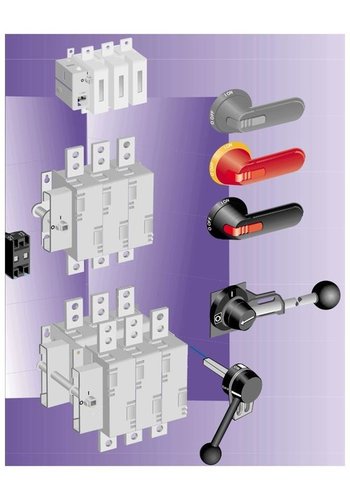
Switch Disconnectors
Product Details:
- Product Type Switch Disconnector
- Plastic Material High-grade Flame Retardant Plastic
- Rated Current 32A
- Rated Voltage 415V AC
- Protection Level IP65
- Voltage 690V
- Standard IEC 60947-3
- Click to View more
X
Switch Disconnectors Price And Quantity
- 1 Piece
Switch Disconnectors Product Specifications
- 4 Pole
- 415V AC
- Standard Modular
- 165mm x 85mm x 90mm
- 1000V
- Three Phase
- 50/60 Hz
- 690V
- 32A
- Switch Disconnector
- 0.65 kg
- IEC 60947-3
- High-grade Flame Retardant Plastic
- IP65
Switch Disconnectors Trade Information
- 100 Piece Per Month
- 4 Week
Product Description
General Characteristics
- A DC Load Break Switch is normally used as Main and/or Bypass on-load Disconnector in DC systems for:
- isolating a line for safety or maintenance purpose
- connecting two adjacent sections of the same line in the event of failure of one or more feeders
- switching a line from one feeder to the other in case of failure of one of them
ON-LOAD operation guarantees a very high level of service continuity as requested by the modern substations design.
COET LB Load Break switches are available in a large range of current ratings and in single or two pole version, thus allowing to meet different applications.
Advantages
SERVICE CONTINUITY
On Load operation, allows a network reconfiguration without supply interruption
CONTROL
Remote control available thanks to motor operation
FLEXIBILTY
Different sizes from 1000 up to 6000A to cover all the different requirement of traction market.
MAINTANANCE
Arch chute removable and contacts inspection allow easy maintenance. Motor control device available in remote position (ground level) for pole mounting version.
SAFETY
Always manual operation system available for emergency situation
Robust and Reliable Construction
Designed to excel in industrial settings, these switch disconnectors feature high-grade flame-retardant plastic housings and durable silver alloy contacts. Their rugged construction supports extended mechanical and electrical life cycles, making them well-suited for frequent switching demands.
Superior Protection and Safety
Rated to IP65, our disconnectors ensure strong protection against dust and water ingress, safeguarding internal components and operators alike. Their insulation voltage of 1000V and short circuit withstand of 10kA meet stringent safety requirements, offering peace of mind in critical installations.
Flexible Installation and Operation
These units come with screw-type terminals and are designed for surface or panel mounting, enabling quick and reliable installation. Compact dimensions (165mm x 85mm x 90mm) and standard modular sizing make integration straightforward within new or existing electrical panels.
FAQs of Switch Disconnectors:
Q: How do the mechanical and electrical life ratings benefit industrial users?
A: With a mechanical life of 10,000 operations and an electrical life of 2,000 operations at rated load, these disconnectors ensure long-term, dependable service. This reduces maintenance frequency and operational downtime, especially in demanding industrial environments.Q: What is the recommended installation process for these switch disconnectors?
A: Installation is straightforward due to their surface or panel mount design and screw-type terminals. Ensure power is off before mounting securely to a flat surface or panel using appropriate fixings, then connect the wiring according to IEC 60947-3 guidelines.Q: Where can these disconnectors be used effectively?
A: These units are ideal for industrial and commercial applications requiring robust performance, such as manufacturing plants, distribution boards, and control panels. Their high insulation voltage and IP65 rating make them suitable for environments exposed to dust and moisture.Q: What makes the silver alloy contacts advantageous in this switch disconnector?
A: Silver alloy contacts offer superior electrical conductivity and resistance to wear and arcing, ensuring efficient current flow and reducing the risk of contact degradation, ultimately extending device longevity.Q: When should a switch disconnector be used in a three-phase setup?
A: Switch disconnectors are crucial for safely isolating electrical equipment during maintenance or emergencies in three-phase power systems. Theyre typically used at the beginning of power feeds or to isolate major loads for service.Q: How does the IP65 protection level enhance user safety?
A: The IP65 rating shields internal components from dust and low-pressure water jets, reducing the possibility of accidental contact or electrical faults, which is essential for operator safety in industrial environments.Q: What are the main benefits of choosing a modular size and standardized design?
A: Modular, standardized sizing simplifies the integration process into existing installations and ensures compatibility with widely-used panel and enclosure types, allowing for scalable and flexible system configurations.Tell us about your requirement

Price:
Quantity
Select Unit
- 50
- 100
- 200
- 250
- 500
- 1000+
Additional detail
Mobile number
Email

Other Products in 'Low Voltage Switchgears ' category


Contact Details
Super Electrical Co.
GST : 07AADFS1979F1Z1
GST : 07AADFS1979F1Z1

- NE-92,96,97,98 Vishnu Garden, Khayala Village, New Delhi - 110018, India
- Phone :08045803322
-
 superelectricalco@gmail.com
 Send Inquiry
- Mr Kuldip Singh (Proprietor )
- Mobile :08045803322
 Send Inquiry
 Send SMS
 |
SUPER ELECTRICAL CO.
All Rights Reserved.(Terms of Use) Developed and Managed by Infocom Network Private Limited. |
